
By
Kevin H. Posey
Here's a question for you to consider: If a road is congested, should it be widened? If you answered yes, can you name a major urban highway expansion project that didn't revert within five years to the same average traffic speed as before the expansion?
Don’t try too hard, because they don’t exist.
Widening a road to alleviate congestion is an intuitively obvious solution to most Americans. Generations of planners reinforced this thinking by leading the public— and themselves— to think of traffic as being like water. The use of terms and concepts like Traffic Flow Models, fluid dynamics, and compression waves are a means by which highway planning professionals remove individual driver decisions from the process and replace them with mindless liquid. If there is too much flowing liquid in a channel, the impulse is to widen the channel to prevent backups. If traffic is viewed as a fluid, road expansions become the default choice for alleviating traffic congestion.
You can see this attitude in play in metropolitan areas all over the US. Whenever a road gets busy, planners look for ways to widen it, no matter what the effect may be on communities abutting the road. Homeowners along Georgia 400 north of Atlanta are continually losing parts of yards or even entire homes because commuters further out believe a wider road will speed up their drive times. Planners can leverage this belief to justify expansion projects.
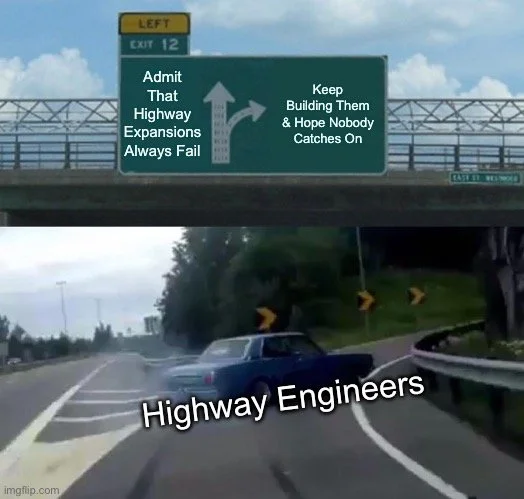
Too bad it doesn’t work. Consider the Katy Freeway in Houston, an expansion project completed in 2011. Local planners and politicians believed it would remedy a major congestion problem with its astounding 23 lanes. Immediately after the project was completed, congestion dipped…briefly. Three years later congestion was 30% worse.
Need another example of a road expansion failure? Look at the experience of Los Angeles when the 405 Freeway was expanded in 2012 to 14 lanes in spots with a carpool lane. Traffic congestion returned just a few years later. Curiously, when the road was closed entirely one weekend during construction, a much-ballyhooed “Carmageddon” of gridlock throughout the entire region failed to materialize. People opted to stay away from the entire corridor to avoid delays.
Removing a traffic bottleneck does no good for the bottlenecks that remain and may exacerbate the problem by tempting more drivers onto the roads, a phenomenon known as Induced Demand. This demonstrates the basic fallacy with treating traffic as if it were water: Water is not a rational actor. Water can't be tempted. Likewise, if the flow is too great, water can't opt to move its source closer to its destination. Nor, for that matter, can it move its destination closer to its source.
Human beings do this all the time. That's why home prices in close-in, walkable neighborhoods around large urban centers throughout the US have seen their property values spike over the last quarter century. Destinations in such places are closer to residences than is typically the case in outer suburbs. Suburban real estate prices would be in trouble, if COVID hadn’t taught employers that work-from-home was a viable option.
The convenience of destinations close to residences plus the availability of high density development means that more people can live, work, and so forth in a square mile of Midtown Atlanta than in the northeast suburb of Tucker. Midtown residents don’t have to drive as much, since shopping and employment destinations are much closer to where they live than for those in sprawling Tucker.
Dense, expensive, intown real estate is what one finds in the European Union, Japan, and China. The urban core is where transport links are the most robust. The low-income residential areas are typically located on the distant periphery, as in the case of Paris and its notorious banlieue.
Perhaps that's the hidden story here. America's urban development is resetting to what is the normal global pattern: popular cores with demand declining as one looks further out. This means that America's planning paradigm is in need of a major reboot that drops road projects catering to far-flung communities far down the priority list.